Flooring in a northern home has a hard job. It has to handle dry winter air, humid summers, snow and salt tracked in from the driveway, gravel stuck in boot treads, and in many cases a cold concrete slab underneath. The right choice depends on the room as much as the look. Here is how the main options stack up, and where each one makes sense.
Hardwood and seasonal movement
Solid hardwood is warm, beautiful and can be refinished more than once over its life. It is also a natural material that expands and contracts with humidity.
In Edmonton and Prince George, that means:
- In winter, when indoor air is dry, boards shrink and small gaps can appear between them
- In summer, when humidity rises, those gaps close and boards can swell
- If moisture gets too high, boards can cup or crown
This is normal behaviour, not a defect, but it can be managed. Keep indoor humidity reasonably steady within the range the manufacturer recommends, let the flooring acclimatize in the home before installation, and leave proper expansion space at the walls. Narrower boards and some species tend to move less visibly than wide planks.
Solid hardwood is generally best on main and upper floors over a wood subfloor, and not recommended directly over concrete or in basements.
Engineered hardwood
Engineered hardwood has a real wood top layer bonded to a stable core made of layered plywood or another engineered material. The cross-layered construction makes it more dimensionally stable than solid hardwood, so it handles seasonal swings better.
Benefits:
- The look and feel of real wood
- Better stability in dry winters and humid summers
- Many products can be installed over concrete or over in-floor heat (check the manufacturer's instructions)
- Some can be refinished, depending on the thickness of the top layer
It is still wood, so standing water and wet boots are not its friend.
Luxury vinyl plank (LVP)
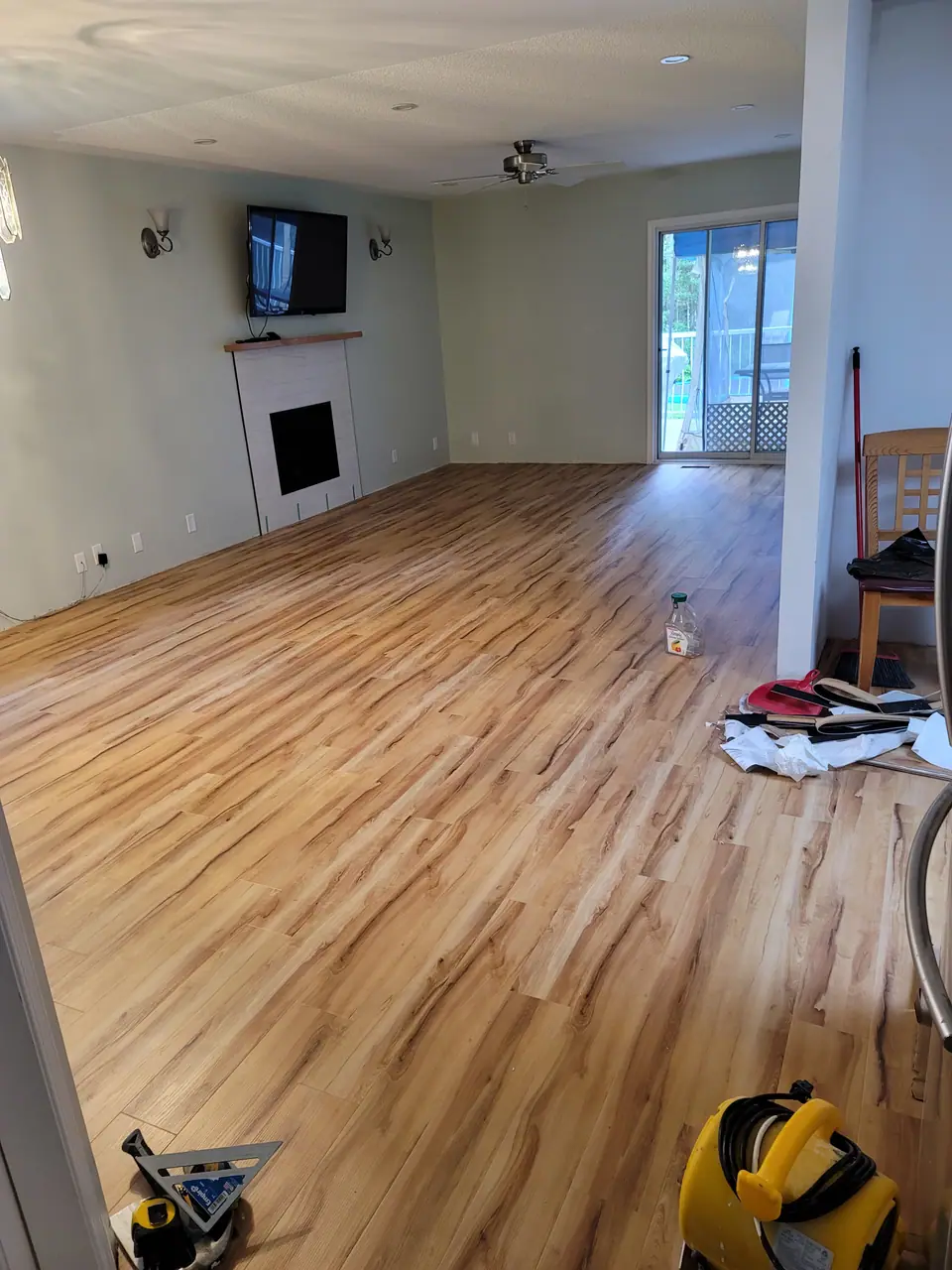
Luxury vinyl plank has become popular for good reasons. It is water-resistant, comfortable underfoot, quieter than many hard floors, and holds up to busy households and pets.
Good places for LVP:
- Basements, over a properly prepared slab
- Kitchens, laundry rooms and mudrooms
- Rentals and secondary suites
- Busy family areas
Things to know: quality varies widely between products, it cannot be refinished like wood, and it can dent under heavy furniture or show scratches from grit. Rigid-core products handle uneven subfloors better than flexible ones, but neither likes a floor that is badly out of flat. Some products also have limits around direct sunlight or temperature swings, which matters near large south-facing windows or in seasonal cabins.
Tile with in-floor heat
Porcelain and ceramic tile are about as durable and water-resistant as flooring gets. The common complaint is that tile is cold, and in a northern winter it really is. In-floor heat solves that.
Electric heating mats or cables are installed under the tile and run on their own thermostat. They are a favourite in bathrooms, ensuites, entryways and kitchens. Some homes have hydronic (hot water) systems in concrete, which work beautifully under tile as well.
Tile needs a stiff, flat substrate. Floors that flex can crack tile or grout, so the subfloor and joists need to be checked and sometimes reinforced. An uncoupling membrane is often used to help tile handle small movements. See our flooring and tile page for the kind of work we do, and our bathroom cost factors article for more on heated floors.
Laminate
Laminate has a photographic image layer over a fibreboard core with a tough wear layer on top. It is scratch-resistant and generally budget-friendly. Newer products have improved water resistance, but many laminates still do not like standing water, and the core can swell if water gets into the joints.
Laminate works well in bedrooms, living rooms and offices. We would think carefully before using it in entryways, bathrooms or basements unless the product is specifically rated for those conditions.
Entryways: snow, salt and gravel
The front and back doors take the worst of a northern winter. Snow melts into puddles, salt residue builds up, and gravel acts like sandpaper underfoot.
For entryways and mudrooms, consider:
- Porcelain tile, ideally with in-floor heat to dry boots and puddles faster
- Quality LVP rated for wet areas
- A good walk-off mat, both outside and inside the door
- A boot tray, bench and hooks so wet gear has a home (our custom millwork page shows built-in options)
Avoid soft woods and delicate finishes right at the door.
Basements over concrete
Concrete slabs are cold and can carry moisture up from the ground. Before any flooring goes down in a basement:
- Confirm the basement is dry, and address any water problems first
- Test the slab for moisture where appropriate
- Use a vapour barrier or underlayment suited to concrete
- Consider an insulated subfloor system to make the floor warmer underfoot
LVP, engineered wood rated for below grade, and tile are the usual choices. Carpet can work in bedrooms or family rooms with the right underlay, but it is not forgiving if water ever gets in. Our basement development article covers moisture in more detail.
Underlayment and subfloor prep
Most flooring problems trace back to what is underneath. Good prep includes:
- Checking that the subfloor is flat within the manufacturer's tolerance, and levelling where it is not
- Fixing squeaks and loose areas before covering them
- Choosing the right underlayment for the product, the room and the sound control you want
- Respecting expansion gaps at walls and transitions
It is not the glamorous part, but it decides whether a floor still looks good years from now.
Choose with confidence
Not sure which flooring suits your home? Book a design consultation. We will look at the rooms, check the subfloor, talk about how your household uses each space, and give you a fixed price in writing. Call Edmonton at (587) 812-4500 or Prince George at (250) 999-4500.